Wednesday, February 3, 2016

The Iliad, Book One: Summary

    wikipedia.org

Book One of the Iliad opens in medias res: the war has been raging between the Trojans and Acheans for ten years. The first word, "Rage," sets the tone for the action that follows, and reminds us of one of the epic's central themes. We are first introduced to Achilles, whose rage threatens to not only destroy him, but to dictate the direction of the war. A skirmish between two leaders of the Acheans, Agamemnon and Achilles has broken out over a matter of the spoils of war: Chriseis and Briseis: two slave girls taken as concubines. But these women are far more than simple concubines: they represent prizes won for contributions to the war and stand as symbols of each man's honor.

The circumstances of the quarrel begin when Chryses, a sage, prays to the god Apollo, to send a plague lest Agamemnon hand over his daughter, Chriseis. The plague lasts nine days. By this stage, Achilles suggests they give up, because there is no use in attempting to fight a war amidst a plague. This, of course, is a ploy by Achilles to shame Agamemnon into giving up his prize. Sitting in a huddle, the men speak to each other. Calchas, a diviner, warns Achilles about his temper, saying, "you know how it is when a king is angry with an underling. He might swallow his temper for a day, but he holds it in his heart until later on and it all comes out" (lines 87-90). Further, he advises that Apollo will not lift the plague until Agamemnon releases the girl back to her father.

Agamemnon is outraged. He begins a rather childish rant that begins, "You damn soothsayer! You've never given me a good omen yet. You take some kind of perverse pleasure in prophesying doom, don't you? Not a single favorable omen ever! (112-115).

Agamemnon wants to keep Chryses' daughter because he likes her far better than his wife, Clytemnestra. He reluctantly agrees to give her up, but not without compensation: if Achilles will offer him his prize, Briseis, then all will be well and they can go back to fighting, plague-fee. 

This suggestion makes Achilles even madder. He says he didn't have a grudge against the Trojans, but he, being a good sport, agreed to fight against them. For all his trouble, he was awarded Briseis, but now he's supposed to give her up? He's ready to walk off and forget this whole war issue. But, just as he's reaching for his sword to slice up Agamemnon, Athena appears only to him, grabs him by his hair and gives him a good talking to. She tells him that his anger will get him nowhere, and that she loves both him and Agamemnon--and besides, if he'll drop it, Agamemnon's arrogance will yield a whole bounty of prizes for Achilles. 

Achilles grudgingly accepts this advisement from the goddess, but he still sounds off at Agamemnon, telling him that he will regret his insolence. Once again, a wiseman steps up to offer some good counsel to Achilles. Nestor tells both Agamemnon and Achilles that he knew some brave warriors who, while being very good in battle, also had the wisdom to heed advice. He says, "taking advice is a good thing" and proceeds to explain: 

"Agamemnon, for all your nobility, don't take his girl.
Leave her be: the army originally gave her to him as a prize.
Nor should you, son of Peleus, want to lock horns with a king. 
A sceptor-holding king has honor beyond the rest of men, 
Power and glory given by Zeus himself.
You are stronger, and it is a goddess who bore you. 
But he is more powerful, since he rules over more.
Son of Atreus, cease your anger. And I appeal
Personally to Achilles to control his temper, since he is,
For all the Greeks, a mighty bulwark in this evil war" (290-299).


Agamemnon is outraged. He begins a rather childish rant that begins, "You damn soothsayer! You've never given me a good omen yet. You take some kind of perverse pleasure in prophesying doom, don't you? Not a single favorable omen ever! (112-115).

Agamemnon wants to keep Chryses' daughter because he likes her far better than his wife, Clytemnestra. He reluctantly agrees to give her up, but not without compensation: if Achilles will offer him his prize, Briseis, then all will be well and they can go back to fighting, plague-fee. 

This suggestion makes Achilles even madder. He says he didn't have a grudge against the Trojans, but he, being a good sport, agreed to fight against them. For all his trouble, he was awarded Briseis, but now he's supposed to give her up? He's ready to walk off and forget this whole war issue. But, just as he's reaching for his sword to slice up Agamemnon, Athena appears only to him, grabs him by his hair and gives him a good talking to. She tells him that his anger will get him nowhere, and that she loves both him and Agamemnon--and besides, if he'll drop it, Agamemnon's arrogance will yield a whole bounty of prizes for Achilles. 

Achilles grudgingly accepts this advisement from the goddess, but he still sounds off at Agamemnon, telling him that he will regret his insolence. Once again, a wiseman steps up to offer some good counsel to Achilles. Nestor tells both Agamemnon and Achilles that he knew some brave warriors who, while being very good in battle, also had the wisdom to heed advice. He says, "taking advice is a good thing" and proceeds to explain: 


"Agamemnon, for all your nobility, don't take his girl.
Leave her be: the army originally gave her to him as a prize.
Nor should you, son of Peleus, want to lock horns with a king. 
A sceptor-holding king has honor beyond the rest of men, 
Power and glory given by Zeus himself.
You are stronger, and it is a goddess who bore you. 
But he is more powerful, since he rules over more.
Son of Atreus, cease your anger. And I appeal
Personally to Achilles to control his temper, since he is,
For all the Greeks, a mighty bulwark in this evil war" (290-299).

Both men are surly and stubborn, returning to petty accusations and cursing at one another. Achilles returns to his encampments and sulks, eventually turning Briseis over to Agamemnon. His pride wounded, he resorts to praying to his mother, Thetis, to do a favor for him. Once upon a time, she helped out the god, Zeus, by setting him free when the other gods bound him. He asks Thetis to plead with Zeus to allow the Greeks to begin losing the war under Agamemnon's leadership--then they will see Achilles worth to them and start showing some respect. Thetis agrees, but not without a deep sense of pity for her son. She wishes he'd stop all this war nonsense and come live with her where he'll be safe. As a mortal, he has only a short life, which is a matter of deep concern here. 

Meanwhile, Chriseis is returned to her father. The Greeks immediately set to work preparing a sacrifice to the god Apollo, so that he will lift the plague. Once all is well, a feast is held. As Zeus returns to Olympus, Thetis makes her request. Zeus agrees--but reluctantly--saying that if he gives in and his wife, Hera, finds out, she will have a fit: she accuses him of favoring the Trojans. And, of course she does. Hera behaves very badly when she finds out about this business and chews her husband out. However, her son, Hephaestus, begs her to be nicer to Zeus, lest his anger spoil their feast. 

Questions: 
At this point, we understand that it is not only Achilles' anger that becomes a concern for the outcome of the war, but the anger of Agamemnon--and even the goddess, Hera. How might we read this text in light of this theme? Is it an allegory? A cautionary tale? 

How are women represented in the text? 

How do the gods respond to the action of mortals? What is their stake in the war?


Wednesday, January 27, 2016

Homer: Eighth Century, B.C.E.

"The Iliad and the Odyssey tell the story of the clash of two great civilizations, and the effects of war on both the winners and the losers. Both poems are about the Trojan War, a mythical conflict between a coalition of Greeks and the inhabitants of Troy, a city in Asia Minor. These are the earliest works of Greek literature, composed almost three thousand years before our time. Yet they are rich and sophisticated in their narrative techniques, and they provide extraordinarily vivid portrayals of people, social relationships, and feelings, especially our incompatible desires for honor and violence, and for peace and a home" (222).


You may recall the opening chapter of your text, which recounts a Dark Age for Greek society. This period came after a nearly 600-year reign by the Myceneans. Not until the eighth century, B.C.E., when a nomadic trading people, the Phoenicians, introduced a variety of formal writing, did Greece have a written literature: instead, Greek history was preserved during this 'dark age' through the recitation of folk legend, as in the Iliad and the Odyssey epics. Your text points out the irony that an "illiterate bard" who sang the lines of the great epics did so against the emergence of written texts--and the fact that if recited in full, the Homeric poems would have held audiences for up to twenty hours. The editors conclude that these poems ascribed to Homer were the work of either a bard who became literate, or the collaborative work of bard and scribe (223).

The term "epic" translates from Greek as "story" or "word" and focuses on the exploits of heroes. Further, as narratives of their culture's history, the epics Iliad and Odyssey became well-known throughout the ancient world, appearing as murals on pottery and interiors, and represented in countless ways through performance and committed to memory.  

Introduction to Greek Epic Poetry: The Iliad


The term 'epic' refers to a 'word, story, poem'"; a "lengthy narrative poem, ordinarily concerning a serious subject containing details of heroic deeds and events significant to a culture or nation"(1).

The Iliad (Song of Ilium) is an epic poem that tells of the last weeks of the Trojan War: a clash between two ancient civilizations, the Greeks and the Trojans, and the impact of this clash on both cultures. Though the epic poem serves as a kind of mythos for the historical evolution of Greece's early history, the narrative conveys enduring and human themes concerning "social relationships and feelings, especially our incompatible desires for honor and violence, and for peace and a home" (222).


The historical background of the Iliad begins in about 2000 B.C.E., on the island of Crete. The inhabitants, a people called the Myceneans, initiated a great empire of enormous 'fortified cities' constructed around 'central central palaces.' The tools and weapons that they used were mostly made of bronze--thus historians refer to this period of Mycenean industry as the Bronze Age. The Bronze Age endured for approximately 600 years until the civilization disappeared in around 1200 B.C.E. All traces of the Mycenean culture, including the syllabary--a method of writing in which syllables were designated by symbols--vanished. A dark period ensued, until writing was reintroduced by the Phoenicians.


Although 'literature' and writing, in the traditional sense of the words, disappeared during this period of 'darkness,' Greeks kept alive their historic and mythic past through an oral tradition: legends and myths about a glorious past were transmitted verbally from generation to generation. In the case of the Iliad and its sequel, the Odyssey, recitation of either of these epics would have lasted several hours--much longer than any one bard could manage at once. Scholars believe that perhaps these epics were the productions of an "oral poet or poets who became literate" and were thus able to record the content of each epic in writing (223). As posterity would suggest, these epics have exercised a pervasive power not just in the ancient societies of Greece and Rome, but in the modern world of literature as well.


Background Synopsis of the Iliad


The epic poem the Iliad is also referred to as the Song of Ilium, as Ilias is another title for Troy. Our text provides a compact synopsis of the epic, which begins in medias res: the actual action of the epic commences in the final year of the war.


"Paris, a prince of Troy, son of King Priam, had to judge which of three goddesses should be awarded a golden apple: Athena, goddess of wisdom; Hera, the queen of the gods--a representative of power; or Aphrodite, goddess of sexual desire. He chose Aphrodite, and as his reward she gave him the most beautiful woman in the world, Helen of Sparta, as his wife. Unfortunately, Helen already had a husband: Menelaus, brother of the powerful general Agamemnon. When Paris took Helen with him back to Troy from Mycenae, Agamemnon and Menelaus mustered a great army, a coalition drawn from many Greek cities, including the great heroes Achilles, the fastest runner and best fighter, and Odysseus, the cleverest of the Greeks. So began a war that lasted ten years, until Odysseus finally found a stratagem to enter the city walls of Troy. He built a wooden horse, filled it with Greek armed men, and tricked the Trojans into taking the horse into the city. The Greek soldiers leaped from the horse and killed the male inhabitants, captured the women, and razed the city to the ground" (223-4).


Themes:

Rage (Particularly that of Achilles': "his rage against the Greeks shifts into an inhuman aggression against the Trojans")
Heroic Code (Death for Glory)
Indecision
Homecoming
Respect
Honor
Fate
Conflict 
  -between mortals and gods
  -among men

Hierarchy
Mortality
Loss
Ransoming of Human Bodies

Characters: Achaeans (Greeks)

Achilles: Leader of the Myrmidons (minions); Son of Thetis, a nymph
Agamemnon: King of Mycenae; Greek leader
Odysseus: Commander and king of Ithaca
Menelaus: King of Sparta
Helen: Wife of Menelaus
Diomedes: King of Argos
Ajax the Greater: King of Salamis
Ajax the Lesser: Partner to Ajax the Greater
Patroclus: Achilles' companion
Nestor: King of Pylos, advisor to Agamemnon
Clytemnestra: Wife of Agamemnon

Characters: Trojans

Hector: Son of King Priam of Troy
Aeneas: Son of Aphrodite
Priam: King of Troy
Paris: Lover to Helen
Polydamas: Commander 'whose advice is ignored'
Hecuba: Priam's wife
Helen: Daughter of Zeus, wife of Menelaus
Andromache: Wife of Hector, Mother to Astyanax
Cassandra: Priam's daughter
Briseis: Trojan woman whom the Greeks captured; Achilles' spoil

The gods' role in the Iliad provides a sharp contrast to the mortal participants of this war: they, unlike their mortal counterparts, can "participate in the war but cannot die." Thus their resilience makes readers acutely aware of the impermanence of life. In other ways, they mirror humankind's follies and mistakes, because "there are conflicts about hierarchy, just as there are on earth: sometimes the lesser gods refuse to recognize the authority of Zeus, just as some Greek chieftains sometimes refuse to bow to Agamemnon. But on Olympus, all quarrels end in laughter and drinking, not death. The most important fact about all the warriors in the Iliad is that they die" (226). Yet, before departing this world, mortals must face the pain of loss, uncertainty, war, violence, grief. 

The Gods of the Greek Pantheon

One of the most significant themes in Homer's Iliad is that of the role of the gods in the lives of mortals. The Greek pantheon features numerous gods who preside over specific aspects of nature or serve specific functions in the complex relationships among humans. The gods reside at Mount Olympus, the mythical home of the gods where Zeus presides.

In the Iliad, as in most other examples of Greek epic and drama, the gods seldom interfere in the lives of mortals--unless called upon to do so. The modus operandi for most gods is not typically beneficence or protection of mortals; rather, most are fairly self-serving, performing roles similar to that of the trickster, in which they exhibit the heights of human folly. When Thetis appeals to Zeus to intervene in the war between the Greeks and Trojans, she asks him to allow Troy the upper hand so that the Greeks will recognize the value of Achilles. Zeus reluctantly agrees, fearful of the grief he will endure from Hera. An argument ensues between these divine royals: Hera accuses Zeus of interfering with mortals; later, their son, Hephaestus begs his mother not to ire Zeus, because his temperament will spoil the festivities of the gods. The scenario emerges as an ironic contrast to the real-life war taking place among mortals, and the internal conflicts that occur between players Achilles and Agamemnon. 

Greek myth and the corresponding gods that populate them have endured and pervaded western literature and culture. Later, as the Romans adopted the pantheon, gods were renamed with latinate titles, and their dominions modified and expanded. The greco-roman pantheons continue to inspire and influence all facets of western culture in music, literature, art, and advertising. 

Hera: Wife and sister to Zeus; goddess of women and marriage. Roman counterpart: Juno


Zeus: "Father of the gods and men"; god of the sky and thunder; Roman counterpart: Jupiter
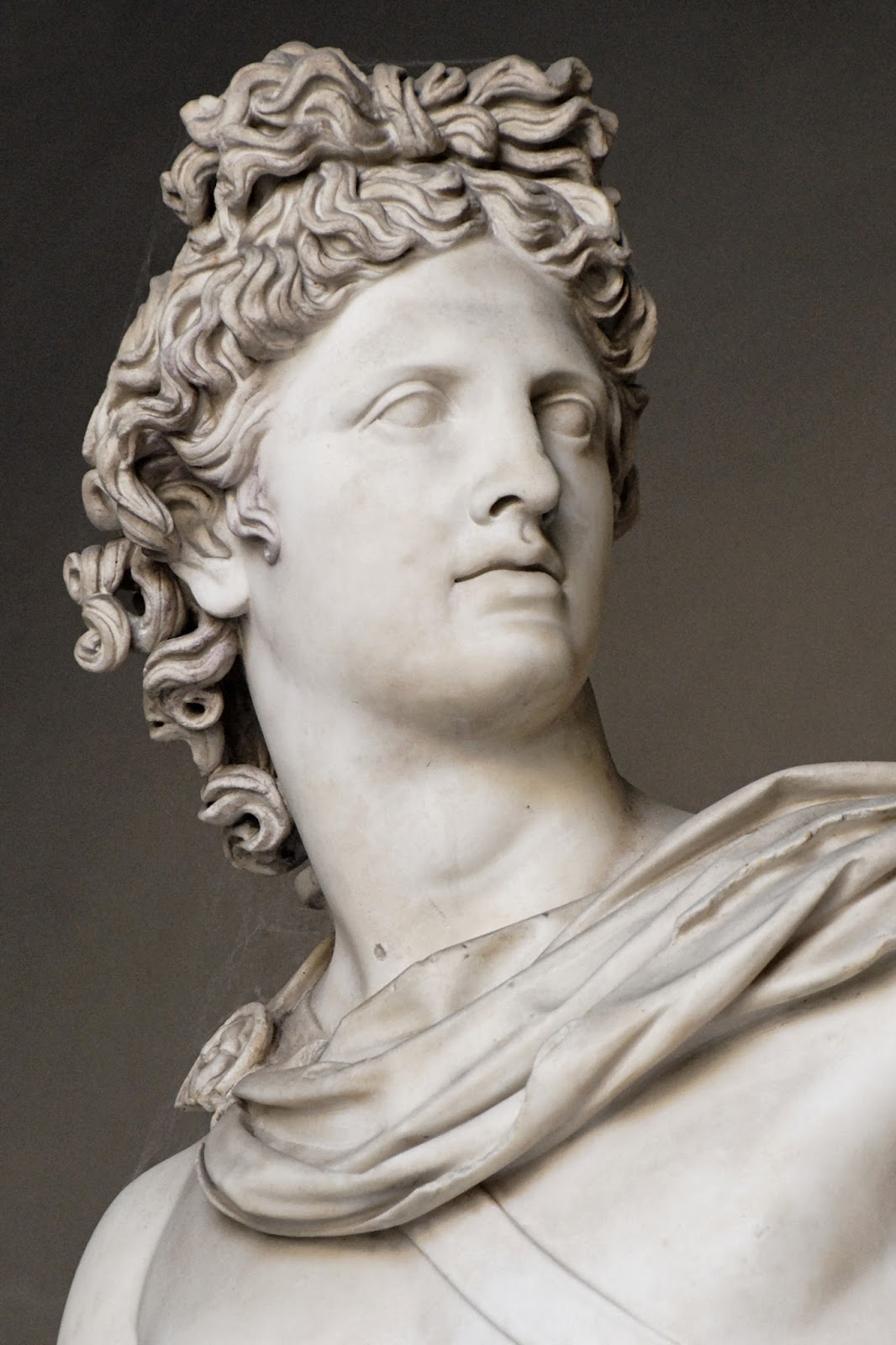
Apollo: Son of Zeus and Leto; Alternately the god of illness and good health; twin brother to Artemis; "light and sun, healing and plague, music and poetry" are associated with Apollo. 

Aphrodite: Goddess of love and beauty; associated with Hephaestus and Adonis; awarded Paris the gift of Helen, wife of Menelaus. Roman counterpart: Venus.

Artemis: Goddess of the hunt, chastity, the wilderness. Daughter of Zeus and Leto; Twin sister to Apollo. Roman counterpart: Diana.


Athena: Patroness of Athens; Daughter of Zeus and Metis; Roman counterpart: Minerva.

Hephaestus: Son of Zeus and Hera; God of blacksmiths, artisans, craftsmen. Roman counterpart: Vulcan.


Monday, January 25, 2016

Lucretius: On the Nature of Things/De Rerum Natura

"The epic On the Nature of Things, by Lucretius (ca. 99-55 B.C.E.), is the only surviving work of an Epicurean Roman poet. Epicurus was a Greek philosopher who lived in the fourth an third centuries B.C.E., and whose philosophy emphasizes tranquility or peace of mind as the primary goal of human life. Epicureans believed that false beliefs--about the origins and nature of the universe and about death--and false fears about the gods are the primary sources of human anxiety." In fact, the modern adaptation of the word epicurean refers to someone who loves luxury. 

Epicureans "were not atheists" as the text reports, but imagined the gods as separate from humanity, living at the perimeter of the universe in a state of perpetual harmony and contentment. Unlike the gods of the creation epics we've studied so far, and those of many religious traditions, the gods of the Epicurean mind had nothing to do with the creation of the universe or human dealings. 

                                               en.ela.mobi

Lucretius, or Titus Lucretius Carus, about whom little is known, is thought to have had an upbringing of wealth and prosperity, having received an education in Philosophy as well as in Greek and Latin. His poem, On the Nature of Things, though lost for many centuries, seems to have had great influence on the poet Virgil and on the Atomists--philosophers who theorized that the universe was composed of two principles: Atom and Void. Atoms, which float independently or in 'clusters' are the building blocks of solid matter in the atmosphere (1). Our text points out that Lucretius stages an 'interplay' between the pragmatic and the fanciful--between 'science and mythology': while he rejects the notion of gods ruling the universe, his first lines intone the power of the goddess, Venus (Aphrodite), to "control every aspect of life on earth". Could this predilection to combine the scientific and the beatific be complimentary or contradictory? Further, what can be said about his remark that "Too often Religion Herself gives brith to evil and blasphemous deeds"? 

Sunday, January 24, 2016

The Birth of Monotheism: Great Hymn to the Aten

The Pharaoh Akhenaten worships the Aten (Wikipedia.com)

King Akhenaten (Pharaoh Amenhotep IV), with whom the Great Hymn of the Aten is associated, introduced Atenism: a new religious form that centered on a single god called Aten. This religious development was a radical change from the traditional polytheistic forms of ancient Egypt, which imagined Aten merely as a minor god in the pantheon of Ra, the sun god. Until Amenhotep's religious revolution, Aten was identified symbolically by a disc, representing the gods alliance with the god, Ra.


During the first years of his reign in the 14th century B.C.E., Akhenaten instituted a religious revolution--alternately referred to by scholars as the Atenist Revolution or the Armana Heresy, in which the Pharaoh ordered the sole worship of this god, erasing all references to polytheism on temples and public buildings; further, no longer was Aten represented by a disc, but through phonetic orthography.

In Year Five of his reign (ca. 1346 B.C.E.), King Amenhotep commenced building a capital city, Akhetaten in what is now Amarna, removing the locus of political and religious power from Thebes. Scholars observe that this removal metaphorized the king's realignment with the god. In observance of the divine rule of kings, Amenhotep IV officially rechristened himself Akhenaten, which translates to "Spirit of the Aten." Once there, the alignment was cemented and the hierarchy was clear: "the Egyptian people could worship Akhenaten; only Akhenaten and Nefertiti could worship Aten" (1).

There is controversy among Egyptologists concerning whether the cult of Aten was in fact truly monotheistic: The proto-monotheism that the Pharaoh introduced acknowledged only one god; however, some theorists believe the worshipers acknowledged the possible existence of other, minor gods. This practice is referred to as henotheism (Norton 29). 

The Hymn: According to scholars the hymn suggests that despite the presence of a priesthood "devoted to Aten, only to Akhenaten had the god revealed itself, and only the king could know the demands and commandments of Aten, a god who remained distant and incomprehensible to the general populace" (2). Although the 

hymn confers access to Aten exclusively to the king, the stele 

(pictured above) implies that "his family was part of his inner 

circle); in other words, that Aten was in fact accessible to the 

royal family. 


In this video an actor recites the Great Hymn to the Aten: As you listen to the recitation, think about how the lines are altered or extemporized. What do these alterations mean to your reading of the Hymn?